














The European Union strengthened its position in global high-technology trade in 2025, recording a €32.4 billion surplus as exports of advanced products exceeded imports for
the second consecutive year, according to Eurostat data.
EU companies exported €566.5 billion worth of high-tech goods last year, compared with €534.1 billion in imports. The result marks a notable turnaround from the period between 2020 and 2023, when the EU consistently recorded deficits in high-tech trade.
The latest figures suggest that Europe's high-tech industries have continued to expand their international reach, while domestic production has also grown substantially over the past decade.
EU high-tech exports have risen by an average of around 7% annually since 2015, increasing by €265.4 billion over the period. Imports have grown at an average rate of approximately 6% a year, adding €239.9 billion.
Domestic manufacturing has expanded at a similar pace. In 2025, EU producers generated €532 billion in sold high-tech products, compared with €287 billion in 2015. That represents an average annual increase of about 6% over the decade.
China and US remain dominant sources of EU high-tech imports
Despite the EU's overall trade surplus, China and the United States remained by far its most important external suppliers of high-tech products.
China accounted for 28% of all EU high-tech imports, worth €150.4 billion, while the United States supplied 25%, or €131.4 billion. Switzerland ranked third, with 6% of imports worth €32.6 billion.
The composition of imports differed significantly between these trading partners.
Nearly half of EU high-tech imports from China — 48% — consisted of electronics and telecommunications equipment, while computers and office machinery represented another 31%.
The United States supplied a substantially different mix of products. Aerospace goods accounted for 36% of EU high-tech imports from the US, while pharmaceuticals represented 33%.
Switzerland's exports to the EU were even more concentrated: 71% of its high-tech shipments were pharmaceutical products.
US is Europe's largest market for high-tech exports
The United States was also the EU's leading destination for high-tech exports in 2025, absorbing €195.1 billion, or 34% of total EU high-tech exports.
The United Kingdom ranked second, receiving €52.5 billion, equivalent to 9% of EU exports. China was third at €48.1 billion, accounting for 8%.
The structure of EU exports to the three markets highlights the different roles they play in Europe's high-tech economy.
Pharmaceuticals dominated EU exports to the United States, accounting for 62% of the total. Aerospace products made up a further 12%.
Exports to the UK were considerably more diverse. Pharmaceuticals represented 23%, while aerospace and electronics-telecommunications products each accounted for 19%. Scientific instruments contributed another 13%.
The EU's high-tech exports to China were similarly diversified. Electronics and telecommunications products represented 30%, followed by aerospace at 27%, scientific instruments at 20% and pharmaceuticals at 13%.
Europe's high-tech sector expands despite global competition
The figures point to a significant expansion of Europe's high-tech production and international trade over the past decade. Between 2015 and 2025, the value of EU high-tech production increased from €287 billion to €532 billion, while both exports and imports also recorded strong growth.
The return to a trade surplus in 2024 and its continuation in 2025 indicate that EU high-tech exports have recently been growing sufficiently to outweigh the bloc's substantial dependence on imported advanced products.
At the same time, the trade figures underline the EU's complex position in global technology supply chains. China remains a crucial supplier of electronics and computing equipment, while the United States is an important source of aerospace and pharmaceutical products and by far the largest destination for EU high-tech exports.
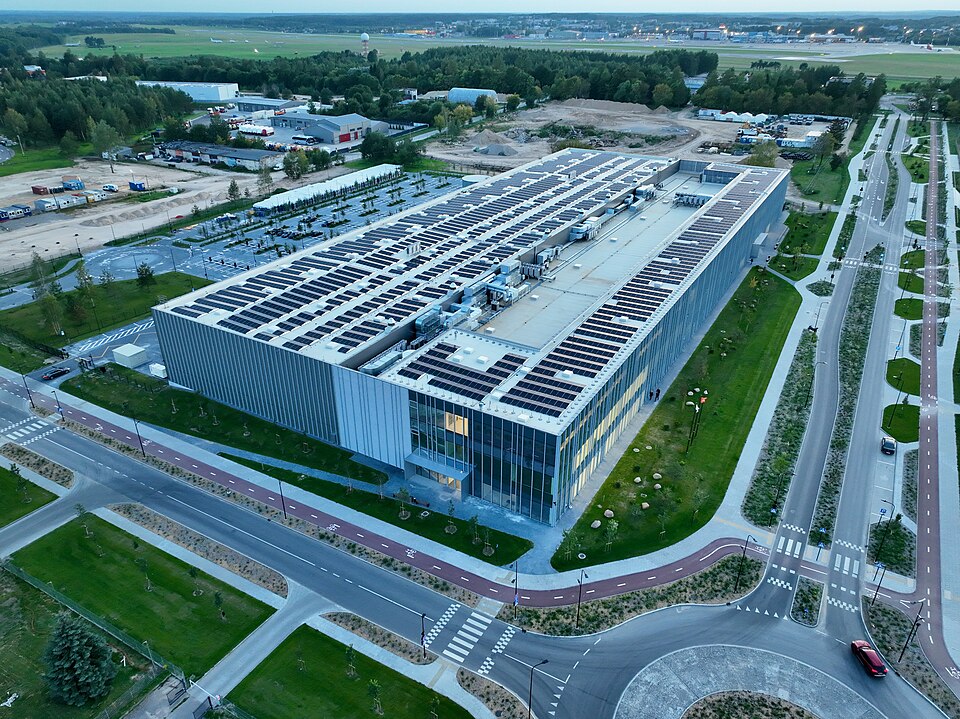
Overall, the data show an increasingly internationalised European high-tech sector, with pharmaceuticals, aerospace, electronics, telecommunications and scientific instruments playing major roles in the bloc's global trade. Photo by CatsEverywhere, Wikimedia commons.