










“Check against delivery”
Dear Vice-President, dear Roxana,
Thank you for your warm words.
Dear Ministers,
Dear Members of the European Parliament,
Ladies and gentlemen,
It is a pleasure to be here with you today – to see employers, trade unions, government and civil society gathered in one place. That spirit of partnership is the foundation of Europe's social model. It reflects our conviction that economic progress and social rights go hand in hand. Eighty years ago, one of the founding fathers of modern Europe, Konrad Adenauer, put it simply – ‘The economy should serve the people, not the people the economy.' That sentence captures the essence of Europe's model. And it is precisely this approach that we need today. Because in a fast-changing world, Europe's economy can only serve its people if it remains competitive.
Competitiveness is not an end in itself. It is what underpins our citizens wellbeing and sustains our social model. It shapes citizen's daily lives – their jobs, their security, their standard of living. It determines if we can compete with global giants on AI and digital technology. It is precondition to keep strategic industries in Europe. These are factors that directly affect people's livelihoods. And they determine Europe's ability to shape its own future. And this is why we put competitiveness at the heart of our agenda. Because a strong social Europe needs a strong economic foundation. And a competitive Europe must remain a social Europe.
I am confident we can meet the challenges ahead, because we have done so before. At the start of this decade, during the darkest days of the pandemic, many feared mass unemployment on a scale not seen since the 1930s. We defied those predictions, together. It needed all hands-on deck. The Commission proposed and you all supported. Employers, trade unions, governments and civil society. We implemented SURE in record time. The SURE program kept workers employed in companies during the lockdowns. We counted on being the first to take orders when the economy opened up again, because we kept the skills in place. And it worked. We protected 40 million jobs. We kept the knowledge and the skills in Europe. Then, with NextGenerationEU, we restarted our economic engine and accelerated the clean and digital transitions.
Today, 3.5 million Europeans are employed thanks to NextGenerationEU investments. 31 million have benefitted from training and education. And reforms are delivering real change – Quality jobs with open-ended contracts in Spain, better reconciliation of work and family in Croatia, stronger apprenticeships in France. It has delivered concrete results: Better opportunities and more security for workers. That is Europe's social market economy in action.
Today, many are worried about Europe's ability to compete. Companies are restructuring. Industries face intense global competition, often from heavily state-subsidised rivals. And many Europeans are asking how AI will impact their future. We face a deep and fast transformation. So, we must stay ahead of the pace of change. Today, I want to focus on three priorities: Completing our Single Market, investing in skills and quality jobs, and addressing the affordability crisis.
Let me start with the Single Market. It remains the engine of European growth and competitiveness. Since its beginning in 1993, the Single Market has raised GDP in the EU by almost 4%. It helped create some 3.6 million jobs. And bringing the Single Market to the next level could double those gains. Enrico Letta, whom you will hear later, calls for the principle of ‘one Europe, one market'. The first point to address is fragmentation. It cannot be, that it is easier for an innovative European company to scale up across oceans than across our own Single Market. We have to overcome the countless barriers between Member States. That is why, later this month, we will propose the 28th regime. It will enable companies to operate under one single and simple set of rules across the Union. And let me clarify that our labour standards will not be put into question. The aim is that businesses can operate across Member States much more easily. To grow here in Europe in one market. To create new and more jobs here in Europe. We will offer a new, truly European company structure. We call it EU Inc. Our entrepreneurs will be able to register a company in any Member State within 48 hours – fully online. They can operate smoothly across borders and access finance in the start-up and scale-up phase operations. That is Europe made simpler.
Ladies and Gentlemen,
The Single Market is not just about companies; it is also about workers. Here too, we can do more to deliver ‘one Europe, one Market'. First, we must make it easier for people to work within the whole Single Market. Therefore, we are developing new digital tools, to simplify access to social security. We can make it easier to hire people, and to provide services across the European Union. This goes hand-in-hand with stronger enforcement through the European Labour Authority. The rules of our Single Market are to be respected.
Second, we must remove the barriers that workers still face when they want to work in another Member State. Free movement is a right, but it is held back by unnecessary bureaucracy. Let me give you some examples: A nurse is asked for a local postal address as a condition to start work despite not having moved yet. The typical chicken and egg dilemma. A secondary school teacher is left waiting eight months for her diploma to be recognised. A pilot is expected to pay almost EUR 18,000 simply to have his qualification recognised in another Member State. We are one Union. These are skills we urgently need. These obstacles are absurd. They undermine mobility. And they are wasting talent our economies depend on. That is why we will put forward a Fair Labour Mobility package this autumn.
Our Union needs to revive free movement. That leads me to my second point – skills and quality jobs. Across Europe, the speed of change is affecting everyone. The student wondering whether the entry-level job will still exist in an age of AI. The refinery technician asking what the clean transition means for his future. The assistant watching tasks being automated and asking – where do I fit tomorrow? In such a moment, skills are the bridge between uncertainty and opportunity. They are central to our competitiveness, and to people's sense of security. That is the purpose of our Union of Skills: To equip Europeans with the skills they need to thrive in a changing economy.
We can already see this approach in action. In Italy, under NextGenEU, 600.000 people are being trained in digital and other in-demand skills. These programmes are designed together with employers and social partners to ensure they respond directly to labour market needs. And this is one of many examples across Europe.
And we need to go further. I have high hopes for the future Skills Guarantee. It will help people to move from sectors in transition to those sectors that are facing shortages and are desperately looking for skilled personnel. The Skills Guarantee means more investment in upskilling. It means helping companies to adapt jobs as they adopt artificial intelligence. It means unions and employers working together to anticipate changes in the labour market. This is how we prepare our job market for AI and new technologies. That is how we turn transformation into opportunity. By investing in people. By building on our successful tradition of social dialogue. We know that together we can move mountains.
Skills must not only be developed, they must also be valued and rewarded through quality jobs. This is why we are working closely with many of you on the forthcoming Quality Jobs Act. Its aim is simple – We want to ensure strong protection for workers, while supporting competitiveness and productivity in a changing world of work. These are two sides of one coin. Because quality jobs are not only good for workers. They raise productivity, attract talent, and build the skilled workforce we need to compete globally. Quality jobs are good for business. And they are good for Europe.
Ladies and Gentlemen,
Finally, affordability. Nowhere is affordability felt more directly than at home. A home is not just four walls and a roof. It is safety, warmth, a place for family and friends. It is belonging. But for too many Europeans today, home has become a source of anxiety. It can mean debt or uncertainty. Across Europe, the consequences are plain to see. Students turning down university places for lack of accommodation. Young couples delaying starting a family because they cannot afford a place to live. Nurses and firefighters unable to live in the communities they serve. This demands action at every level. That is the purpose of our Affordable Housing Action Plan. We want to curb short-term rentals where they drive up prices. We are removing unnecessary barriers in planning and permitting. We have already revised our State Aid rules to accelerate investment. In our next long-term budget, we will make it easier to direct EU funds into affordable housing. And we will present a Recommendation on Fighting Housing Exclusion. Because today, more than one million people in Europe do not have a home to return to. We cannot accept this. Everyone deserves a safe place to call home.
Ladies and gentlemen,
Across Europe today, many are concerned about the future. About whether their children will have the same opportunities that they did. It is our responsibility to respond. To ensure that the industries of the future are built in Europe. To ensure that workers have the skills to succeed. To ensure that Europe is affordable and fair. To ensure that our social market economy prevails. None of this can be achieved alone. It requires partnership – employers, workers, governments, and civil society, all working together. That is Europe's social model in action. That is how we build a competitive economy. And that is how we build hope.
Thank you. And long live Europe.
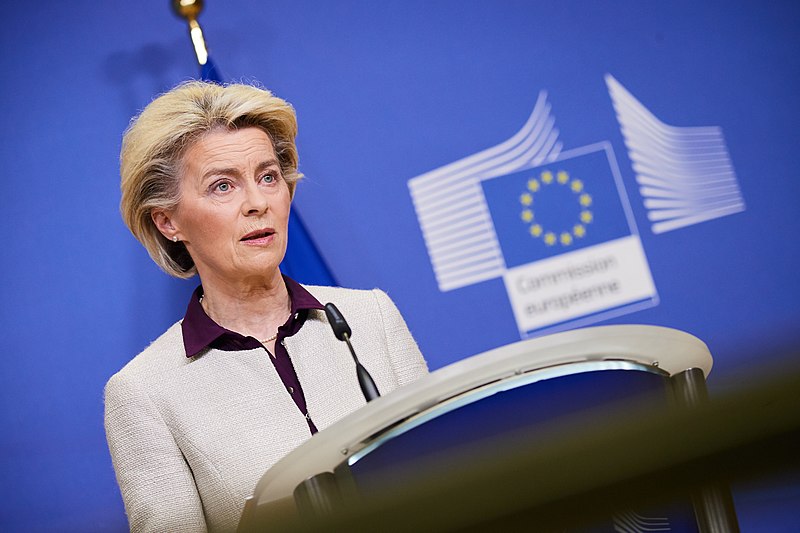
Photo by © European Union, 2026, Wikimedia commons.