















Poland’s lower house of parliament has voted to dismantle the country’s main anti-corruption agency, setting up a potential political clash with the president, who has already
indicated he will block the move.
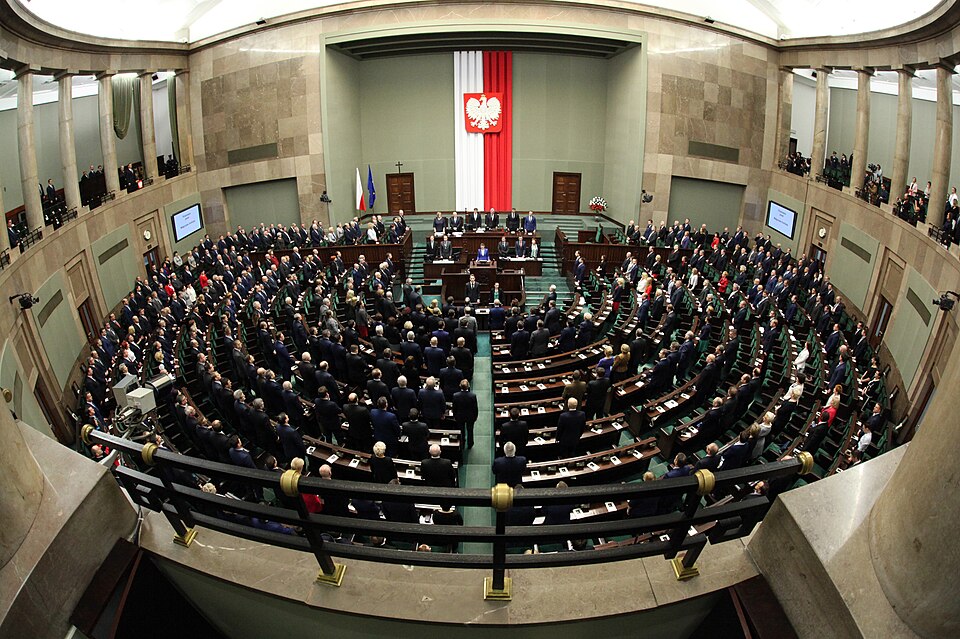
On Friday, lawmakers in the Sejm approved legislation to abolish the Central Anti-Corruption Bureau (CBA), transferring its duties to other state institutions. The proposal was backed entirely by parties in the governing coalition led by Prime Minister Donald Tusk, who argues that the agency became deeply politicised during the rule of the former conservative government.
However, the bill now faces a major obstacle: Karol Nawrocki, Poland’s president and a figure aligned with the opposition Law and Justice (PiS), is expected to veto it once it reaches his desk.
Government argues CBA became politicised
The current coalition government, which spans parties from the left to the centre-right, first announced plans to eliminate the CBA in April 2024, just months after taking power from PiS.
Tusk argued at the time that the agency had largely abandoned its anti-corruption mission during the previous administration. Instead, he said, it was used to target political opponents.
Although the proposal was initially delayed, the government formally submitted the legislation to parliament in October 2025. The Sejm finally voted on the bill this week.
Under the new plan, the CBA—established in 2006—would be dissolved. Its responsibilities would be distributed among the Internal Security Agency (ABW), the National Revenue Administration (KAS), and the national police. Within the police, a new specialised unit called the Central Bureau for Combating Corruption would be created.
Interior and security services minister Tomasz Siemoniak told parliament the changes are necessary to restore neutrality to anti-corruption efforts.
“The CBA is a service that has become politicised,” he said. “It is in the interest of all citizens that the fight against corruption be impartial and free from political pressure.”
Siemoniak argued that strengthening existing institutions—particularly the police—would be more effective than maintaining a separate special service.
Controversies surrounding the agency
The government’s criticism of the CBA partly stems from high-profile controversies linked to its leadership under the PiS government.
Former CBA chief Mariusz Kamiński and his deputy Maciej Wąsik were convicted and imprisoned for abuse of power in a case dating back to an earlier undercover operation. Both later served as ministers in the PiS administration before being pardoned by then-president Andrzej Duda.
The agency also faced criticism over its role in acquiring and deploying Pegasus spyware. The previous government was accused of using the surveillance technology against political opponents rather than suspected criminals.
During PiS rule, Poland’s standing in the annual Corruption Perceptions Index compiled by Transparency International steadily declined. After reaching a high of 29th place in 2015, the country dropped to a record low of 53rd by 2024.
Opposition warns of weakened oversight
Opposition politicians say the government’s plan risks undermining anti-corruption enforcement.
A spokesman for PiS, Piotr Müller, accused the ruling coalition of dismantling institutions instead of strengthening them.
“Instead of reinforcing the state’s ability to fight corruption, the government is dismantling it,” he wrote on social media, warning the move could have serious consequences for national security.
Another PiS lawmaker, Władysław Dajczak, suggested the decision was motivated by political revenge against the agency for investigations involving politicians now in power.
Parliamentary vote and next steps
In Friday’s vote, 231 members of parliament supported the bill—all from the governing coalition—while 180 lawmakers voted against it. The opposition votes came mainly from PiS, along with four members of the small left-wing party Together (Razem). The far-right Confederation (Konfederacja) abstained.
The legislation now moves to the Senate, which can delay the process or propose amendments but cannot ultimately block the law.
Afterward, the bill will be sent to President Nawrocki, who can sign it into law, veto it, or refer it to the constitutional court.
His chief of staff, Zbigniew Bogucki, has already made the president’s position clear.
“I don’t know of any democratic government in Europe that would want to abolish an institution responsible for fighting corruption,” Bogucki said. “The president does not agree to this.”
If the veto happens, the government has suggested it may still attempt to shift some of the CBA’s responsibilities to the police through other legislative or administrative measures. Photo by The Chancellery of the Senate of the Republic of Poland, Wikimedia commons.