














An online platform that mapped Jewish-owned businesses, schools, and Israel-linked companies across Catalonia has been linked to promotion by an organization receiving
European Union funding, according to newly released findings by NGO Monitor.
The platform, known as ‘BarcelonaZ’, came under scrutiny after NGO Monitor, a Jerusalem-based research institute that examines political activity and anti-Israel bias among nongovernmental organizations, reported that Engineers Without Borders–Catalonia (ESF-C) and the academic network Universities with Palestine (UAP) publicly promoted the project on social media and identified themselves as its main supporters.
The interactive map, first reported by the Jewish outlet ‘Enfoque Judío’, was launched on GoGoCarto, a French-hosted, open-source mapping platform. Its anonymous creators described themselves as “journalists, professors, and students.” The map pinpointed more than 150 locations, including Jewish schools, kosher food shops, and Israeli-linked companies, as well as Spanish and international firms operating in Israel. All were labeled “Zionist.”
According to the project’s website, its stated aim was to “understand how Zionism operates and the forms it takes” and to “make visible and denounce the impact of its investments in our territory.” Critics, however, said the initiative crossed a red line by singling out Jewish and Israel-associated entities, effectively encouraging discrimination and intimidation.
NGO Monitor’s report highlighted that ESF-C is an EU-funded NGO that runs a Youth Internship Program supported by Catalonia’s Public Employment Service, with 40 percent of the funding coming from the European Social Fund Plus. EU financial records show that between 2019 and 2023, ESF-C partnered on two EU grants worth approximately $2.8 million and received at least $164,000 in EU funding.
Jewish leaders in Spain reacted with alarm, warning that the map created a hostile environment for Jews at a time of rising antisemitism across Europe and beyond.
“The mapping and boycotting of Jewish businesses in Catalonia echoes some of the darkest chapters in history,” said Shannon Seban, Director of European Affairs at the Combat Antisemitism Movement. “It recalls the prelude to the Holocaust in Nazi Germany.”
Seban added that the initiative “puts a target on the backs of Spanish Jews” during a period of heightened global violence against Jewish communities. She referenced a recent deadly attack at a Hanukkah celebration in Sydney, Australia, as an example of the real-world dangers posed by incitement. “Clear incitement to violence of this nature must not be tolerated by internet platforms or authorities,” she said.
On its website, ESF-C describes its mission as promoting a “fair international society” rooted in non-denominationalism and non-partisanship. However, its 2024 annual report states that the organization “cannot ignore the Palestinian resistance,” framing it as part of a broader struggle against oppression.
In social media posts, ESF-C accused Israel of “genocide” during its military campaign against Hamas in Gaza, presenting 'BarcelonaZ' as an educational tool meant to inform and mobilize students in Catalonia. Critics noted that these statements made no mention of the Hamas-led attacks of October 7, 2023, in which terrorists invaded southern Israel and killed civilians, triggering the war.
NGO Monitor also reported that UAP, which co-sponsored the project, is a network of Catalan faculty- and student-led groups known for anti-Israel activism. Last year, UAP organized a so-called “People’s Court” at Complutense University of Madrid focused on what it termed “Palestinian genocide,” with participation from organizations and individuals linked to extremist groups, including Samidoun, Masar Badil, Al-Haq, and activist Raji Sourani.
Following public outcry, several Jewish and civil society organizations filed formal complaints with GoGoCarto, arguing that the platform violated French laws prohibiting hate speech and discrimination.
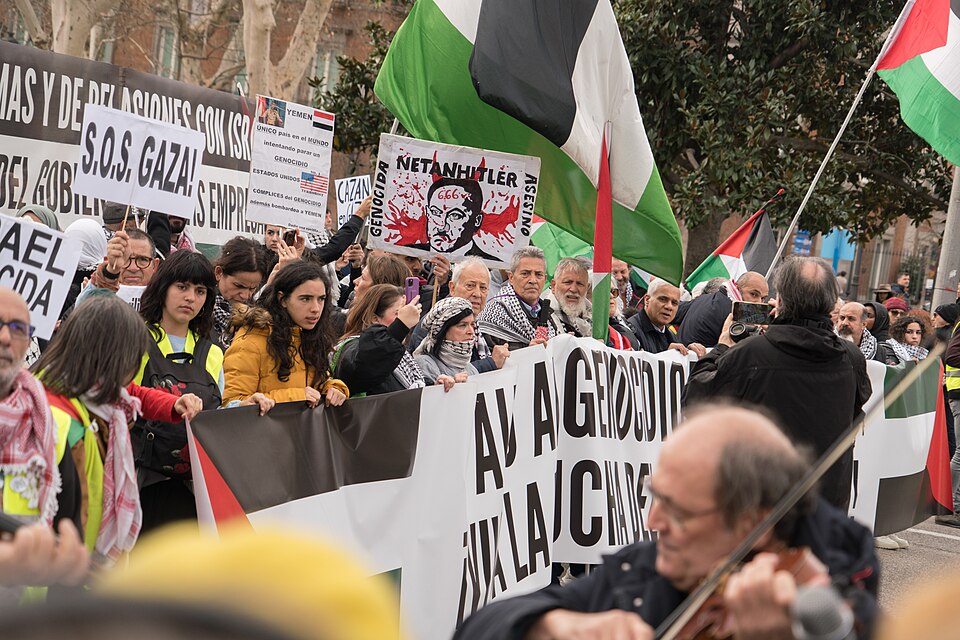
Earlier this week, GoGoCarto announced that it had removed the ‘BarcelonaZ’ map from its website, citing concerns raised by local groups that described the initiative as antisemitic and potentially dangerous. Photo by Nemo, Wikimedia commons.