








When Bassi Konaté was elected mayor of Sarcelles this spring, he did more than unseat a local administration — he marked the end of three decades of Socialist dominance in
the Paris suburb and signaled a deeper shift in France’s political geography.
Running as an independent backed by the hard-left party La France Insoumise, Konaté capitalised on local identity and modern campaigning techniques, blending grassroots canvassing with a strong social media presence. His outreach leaned on an unconventional coalition of rappers, footballers, and online influencers to mobilise younger voters in a town long considered politically disengaged.
A native of Sarcelles and of Malian heritage, the 38-year-old framed his victory as a reflection of contemporary France’s diversity.
“Sarcelles is the most beautiful city in the world because it represents the whole world,” he told Reuters, describing it as “the face of the world in France.”
His win underscores the growing strength of La France Insoumise in France’s disadvantaged urban suburbs, where frustration with traditional parties has become a defining political force ahead of next year’s presidential election.
A shifting political map
As Emmanuel Macron approaches the end of his second term, France’s centrist bloc appears increasingly weakened, squeezed between a resurgent far right and a hard left gaining traction in working-class suburbs.
That vacuum has created space for veteran left-wing firebrand Jean-Luc Mélenchon, now preparing his fourth presidential run. Despite consistently high disapproval ratings, he remains a central figure in national politics — and a contender analysts say could reach the runoff if mainstream forces fragment.
Recent polling shows the far-right National Rally as the frontrunner heading into the first round of voting. But several scenarios still place Mélenchon in a position to advance, reflecting the volatility of an increasingly polarised electorate.
The suburbs as political engine
Sarcelles, a town of roughly 60,000 residents north of Paris, captures many of the tensions shaping France’s future: youth, poverty, and diversity. Home to significant Jewish, Muslim, and immigrant communities, it has become emblematic of the country’s fractured social landscape.
Its former mayor, Patrick Haddad, who lost to Konaté, described France as divided into three political worlds: affluent urban centres leaning centrist, rural areas dominated by the far right, and suburban “banlieues” increasingly turning toward the hard left.
That pattern, he argued, reflects deeper economic and cultural fragmentation rather than temporary protest voting.
Mélenchon’s electorate
For Jean-Luc Mélenchon, the appeal is strongest among younger voters and residents of economically marginalised suburbs. Polling cited by Cluster17 suggests nearly half of voters aged 18–24 and over a third of those aged 25–34 support him — a striking generational divide in French politics.
His platform — higher minimum wages, expanded wealth taxation, tighter price controls, and a strongly pro-Palestinian foreign policy stance — resonates with many in low-income urban districts, while alarming business leaders and centrist rivals.
Critics accuse his movement of polarisation and inconsistency, while supporters argue it speaks directly to communities long ignored by mainstream parties.
A fragmented republic
Local party strategist Manuel Bompard of La France Insoumise describes its base as “the forgotten, the overlooked, the despised” — a coalition that includes gig workers, single-parent households, and residents excluded from traditional labour protections.
In Sarcelles, that sense of political realignment is visible in everyday life, from its sprawling markets to its tightly packed housing estates. The town’s famous Tuesday market — stretching nearly a kilometre and hosting hundreds of vendors — reflects both economic precarity and cultural vibrancy.
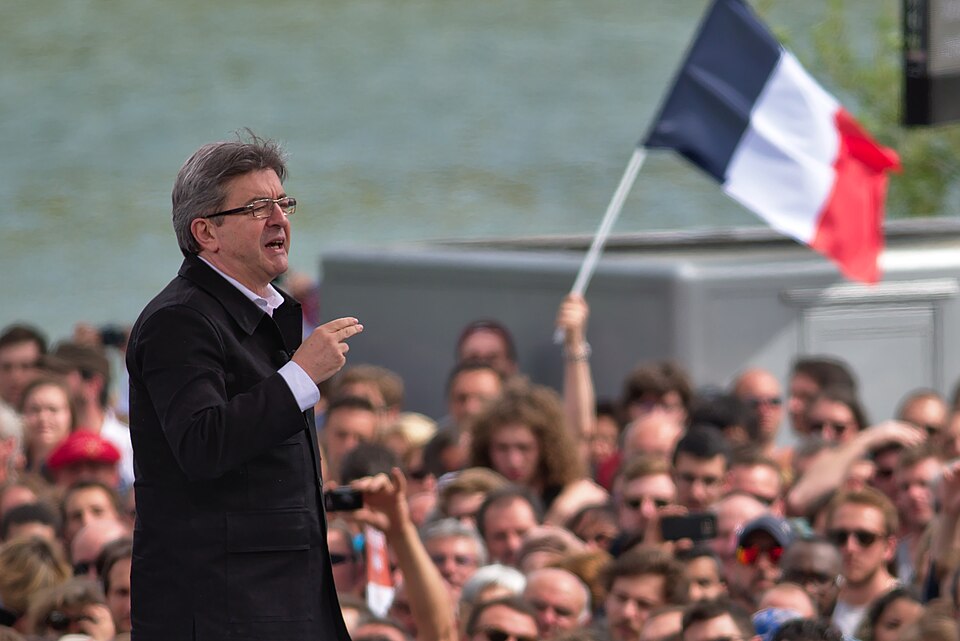
Whether that energy translates into national power remains uncertain. But as France heads toward another contentious presidential race, its banlieues are no longer political margins. They are becoming the centre of the contest. Photo by © MathieuMD / Wikimedia Commons / CC BY-SA 4.0