











"Check against delivery"
Ladies and Gentlemen,
Lieber Klaus,
Dear Olena,
For almost one year now, Ukraine has stunned the world. On that fateful February morning, many predicted that Kyiv would fall in a matter of days. But this did not account for the morale and physical courage of Ukrainian people. You have resisted the Russian invasion and pushed back against the aggressor against all odds. Not even Russia's relentless attacks on civilians or the spectre of a brutal winter have shaken your resolve. In this last year, your country has moved the world and inspired all of Europe. And I can assure you that Europe will always stand with you.
Many doubted whether that support would be so unwavering. But today, European countries are providing more and more critical weapons to Ukraine. We are hosting around four million Ukrainians in our cities, in our homes and in our schools. And we have put in place the strongest sanctions ever which leave the Russian economy facing a decade of regression and its industry starved of any modern and critical technologies. There will be no impunity for these crimes. And there will be no let-up in our steadfast support to Ukraine – from helping to restore power, heating and water, to preparing for the long-term effort of reconstruction. And to reaffirm that support, we announced yesterday that the Commission is delivering EUR 3 billion of financial support. This is the first tranche of our EUR 18 billion support package for 2023. This will bolster Ukraine's financial stability, help to pay wages and pensions, and ensure the running of hospitals, schools, and housing services. We are in it – for as long as it takes.
And Europe's reaction to the war is the latest example in how our Union has pulled together when it matters the most. Take energy. A year ago, Europe had a massive dependency on Russian fossil fuels built up over decades. This made us vulnerable to supply squeezes, price hikes and Putin's market manipulation. In less than a year, Europe has overcome this dangerous dependency. We have replaced around 80% of Russian pipeline gas. We have filled our storages and reduced demand by more than 20% in the period from August to November. And through collective effort, we brought down gas prices quicker than anyone expected. From its peak in August, European natural gas prices have now dropped by 80% this month. That is below the levels of before the Ukraine war. Europe has once again shown the power of its collective will.
Nevertheless, we should be under no illusions how difficult these periods of pandemic and war are for families and for business. And we will have to show that same resolve as we face up to a collision of crises. As your Global Risks Report sets it out, we see rising inflation making the cost of living and the cost of doing business more expensive. We see energy being used as a weapon. We see threats of trade wars and the return of confrontational geopolitics. In addition, climate change already comes with a huge cost and we have no time to lose in the transition to a clean economy.
The net-zero transformation is already causing huge industrial, economic and geopolitical shifts – by far the quickest and the most pronounced in our lifetime. It is changing the nature of work and the shape of our industry. But we are on the brink of something far greater. Just think: in less than three decades we want to reach net zero. But the road to net zero means developing and using a whole range of new clean technologies across our economy: in transport, buildings, manufacturing, energy. The next decades will see the greatest industrial transformation of our times – maybe of any times. And those who develop and manufacture the technology that will be the foundation of tomorrow's economy will have the greatest competitive edge. The scale of the opportunity is clear for all to see. The International Energy Agency estimates that the market for mass-manufactured clean energy tech will be worth around USD 650 billion a year by 2030 – more than triple today's levels. To get ahead of the competition, we need to keep investing in strengthening our industrial base and making Europe more investment- and innovation-friendly. This is what investors are looking closely at in the different global markets for clean tech. Here in Europe, we moved first with the European Green Deal to set the path to climate neutrality by 2050. We have cast our net-zero target into law to provide the predictability and transparency business needs. We followed it up with the investment firepower of NextGenerationEU, our EUR 800 billion investment plan, the Just Transition Fund and other instruments across the economy. This is unprecedented investment in clean technology across all sectors of the green transition. Clean tech is now the fastest-growing investment sector in Europe – doubling its value between 2020 and 2021 alone. And the good news for the planet is that other major economies are now also stepping up. Japan's green transformation plans aim to help raise up to JPY 20 trillion – around EUR 140 billion – through ‘green transition' bonds. India has put forward the Production Linked Incentive Scheme to enhance their competitiveness in sectors like solar photovoltaics and batteries. The UK, Canada and many others have also put forward their investment plans in clean tech. And of course, we have seen the Inflation Reduction Act in the United States, their USD 369 billion clean-tech investment plan. That means that together, the EU and US alone are putting forward almost EUR 1 trillion to accelerate the clean energy economy. This has the potential to massively boost the path to climate neutrality.
But it is no secret that certain elements of the design of the Inflation Reduction Act raised a number of concerns in terms of some of the targeted incentives for companies. This is why we have been working with the US to find solutions, for example so that EU companies and EU-made electric cars can also benefit from the IRA. Our aim should be to avoid disruptions in transatlantic trade and investment. We should work towards ensuring that our respective incentive programmes are fair and mutually reinforcing. And we should set out how we can jointly benefit from this massive investment, for example by creating economies of scale across the Atlantic or setting common standards. At the heart of the joint vision is our conviction that competition and trade is the key to speeding up clean tech and climate neutrality. And that means that we Europeans also need to get better at nurturing our own clean-tech industry. We have a small window to invest in clean tech and innovation to gain leadership before the fossil fuel economy becomes obsolete. We have an industry challenged by a pandemic, supply chain issues and price shocks. We see aggressive attempts to attract our industrial capacities away to China or elsewhere. We have a compelling need to make this net-zero transition without creating new dependencies. And we know that future investment decisions will be taken depending on what we do today.
We have a plan, a Green Deal Industrial Plan, our plan to make Europe the home of clean tech and industrial innovation on the road to net zero. Our Green Deal Industrial Plan will be covering four key pillars: the regulatory environment, financing, skills and trade.
The first pillar is about speed and access. We need to create a regulatory environment that allows us to scale up fast and to create conducive conditions for sectors crucial to reaching net zero. This includes wind, heat pumps, solar, clean hydrogen, storage and others – for which demand is boosted by our NextGenerationEU and REPowerEU plans. To help make this happen, we will put forward a new Net-Zero Industry Act. This will follow the same model as our Chips Act. The new Net-Zero Industry Act will identify clear goals for European clean tech by 2030. The aim will be to focus investment on strategic projects along the entire supply chain. We will especially look at how to simplify and fast-track permitting for new clean-tech production sites. In parallel to this Net-Zero Industry Act, we will reflect on how to make Important Projects of Common European Interest on clean tech faster to process, easier to fund and simpler to access for small businesses and for all Member States. The Net-Zero Industry Act will go hand in hand with the Critical Raw Materials Act. For rare earths, which are vital for manufacturing key technologies – like wind power generation, hydrogen storage or batteries –, Europe is today 98% dependent on one country – China. Or take lithium. With just three countries accounting for more than 90% of the lithium production, the entire supply chain has become incredibly tight. This has pushed up prices and is threatening our competitiveness. So, we need to improve the refining, processing and recycling of raw materials here in Europe. And in parallel, we will work with our trade partners to cooperate on sourcing, production and processing to overcome the existing monopoly. To do this, we can build a critical raw materials club working with like-minded partners – from the US to Ukraine – to collectively strengthen supply chains and to diversify away from single suppliers. This is pillar one – speed and access through the Net-Zero Industry Act.
The second pillar of the Green Deal Industrial Plan will boost investment and financing of clean-tech production. To keep European industry attractive, there is a need to be competitive with the offers and incentives that are currently available outside the EU. This is why we will propose to temporarily adapt our state aid rules to speed up and simplify. Easier calculations, simpler procedures, accelerated approvals. For example, with simple tax-break models. And with targeted aid for production facilities in strategic clean-tech value chains, to counter relocation risks from foreign subsidies. But we also know that state aid will only be a limited solution which only a few Member States can use. To avoid a fragmenting effect on the Single Market and to support the clean-tech transition across the whole Union, we must also step up EU funding. For the medium term, we will prepare a European Sovereignty Fund as part of the mid-term review of our budget later this year. This will provide a structural solution to boost the resources available for upstream research, innovation and strategic industrial projects key to reaching net zero. But as this will take some time, we will look at a bridging solution to provide fast and targeted support where it is most needed. And to support this, we are currently working hard on a needs assessment.
The third pillar of the Green Deal Industrial Plan will be developing the skills needed to make the transition happen. The best technology is only as good as the skilled workers who can install and operate it. And with a huge growth in new technologies, we will need a huge growth in skills and skilled workers in this sector. This will cut across all that we do – whether on regulation or finance – and will be a priority for our European Year of Skills.
The fourth pillar will be to facilitate open and fair trade for the benefit of all. For clean tech to deliver net zero globally, there will be a need for strong and resilient supply chains. Our economies will rely ever more on international trade as the transition speeds up to open up more markets and to access the inputs needed for industry. We need an ambitious trade agenda, including by making the most of trade agreements for example with Canada or with the UK – with which we are trying hard to sort our difficulties. We are working to conclude agreements with Mexico, Chile, New Zealand and Australia; and to make progress with India and Indonesia. And we need to restart a conversation regarding the Mercosur agreement. Because international trade is key to helping our industry cut costs, create jobs and develop new products.
But by the same token where trade is not fair, we must respond more robustly. China has made boosting clean-tech innovation and manufacturing a key priority in its five-year plan. It dominates global production in sectors like electric vehicles or solar panels, which are essential for the transition. But competition on net zero must be based on a level playing field. China has been openly encouraging energy-intensive companies in Europe and elsewhere to relocate all or part of their production. They do so with the promise of cheap energy, low labour costs and a more lenient regulatory environment. At the same time, China heavily subsidises its industry and restricts access to its market for EU companies. We will still need to work and trade with China – especially when it comes to this transition. So, we need to focus on de-risking rather than decoupling. This means using all our tools to deal with unfair practices, including the new Foreign Subsidies Regulation. We will not hesitate to open investigations if we consider that our procurement or other markets are being distorted by such subsidies.
Ladies and Gentlemen,
The story of the clean-tech economy is still being written. Over the years I have been coming to Davos, I have heard many times that we are on the cusp of a period of creative destruction that the economist Joseph Schumpeter spoke of – his idea that innovation and tech replaces the old, leaving the old industry and jobs behind. In many ways, this dynamic applies to the clean-tech revolution of tomorrow. But I believe if Europe gets it right, the story of the clean-tech economy can be one of creative construction – with the right support and incentives for companies to innovate; with the right focus on skills and people; with the right environment to make the most of our world-leading innovation capacity. Europe already has everything it takes – talent, researcher, industrial capacity. And Europe has a plan for the future. And this is why I believe the story of the clean-tech economy will be written in Europe.
Thank you.
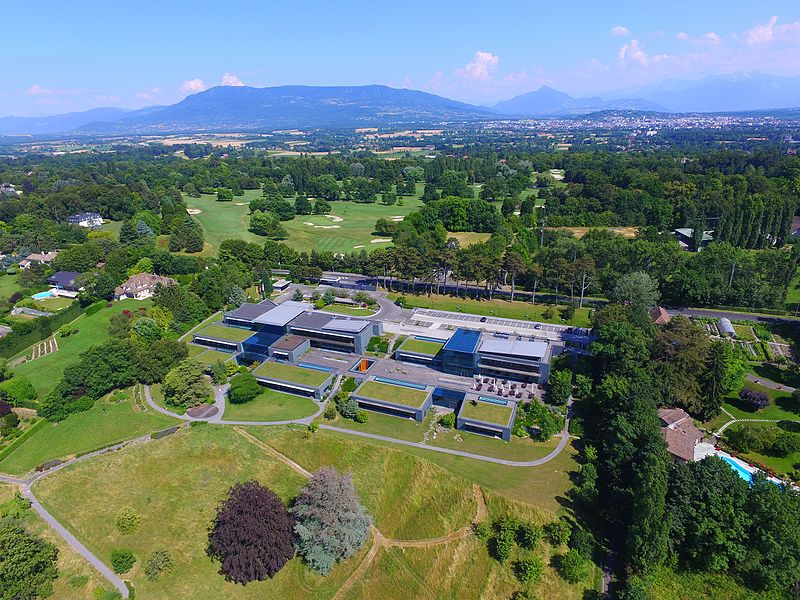
Photo by Alexey M., Wikimedia commons.