










I have been organising this seminar for 23 years now within the framework of the Menéndez Pelayo International University (UIMP). It is an opportunity to step back and engage
with academics, think tankers and actors on the main issues affecting the future of Europe, particularly its foreign and security policy. The EU is facing the major challenges resulting from two wars in its immediate neighbourhood and at the same time the consequences of two important elections, with a new European Parliament and leadership and the forthcoming US presidential elections.
During this seminar, we were able to discuss Europe-Africa relations with the former President of Senegal, Macky Sall; the colossal economic and technological challenges facing Europe and the means to tackle them; relations between the United States and China and what these mean for Europe; the Russian war of aggression against Ukraine and its implications for European defence as well as climate change and the European Green Deal.
It is impossible to give a detailed account of all these rich exchanges. For those interested, debates were recorded and are available online. However, I would like to revisit one discussion in particular: the one on the current crisis in the Middle East. We discussed this conflict with Jean-Pierre Filiu, professor at Sciences-Po Paris and a long-standing specialist of the Middle East history and politics, Philippe Lazzarini, Commissioner General of UNRWA, Fania Oz-Salzberger, professor of history at the University of Haifa, and Dahlia Scheindlin, an international analyst in Tel Aviv.
Jean-Pierre Filiu emphasized that what is generally considered "realistic" about the Israeli-Palestinian conflict has, in fact, never been remotely so. The so-called "realists" have long claimed that the blockade of Gaza could continue indefinitely and that the Palestinian issue would eventually resolve by itself. A similar idea was still formulated by the US national security adviser Jake Sullivan a few days before 7 October. When I took my office in Brussels, five years ago, this "realistic" approach was dominant in the EU: I was advised not to spend too much political energy and capital on an unsolvable issue. However, the terror attacks of 7 October have shown that the status quo was untenable and a looming threat for both the Israeli and Palestinian people. Through their actions or lack thereof, the so-called "realists" have contributed to the current catastrophe.
In Gaza, the future of Europe is at stake
For Jean-Pierre Filiu, nothing less than the future of Europe is at stake in Gaza. All the principles on which Europe is built are being called into question in this war. If Europe gives up defending, not to say enforcing, international and humanitarian law in Gaza and Palestine, it will lose its credibility. Its international position will be seriously and lastingly weakened, in particular regarding the global support to Ukraine against the Russian war of aggression.
And the United States seems to be no longer in a position to bring peace to the Middle East; They tried repeatedly but have consistently failed to do so in recent decades. However, given the new energy realities, the United States can live without lasting peace in the Middle East. Europe cannot. The Union needs to become much more involved in helping to resolve this conflict. It has many levers to do so but it is so far shying away from using them.
The reluctance to take any meaningful action
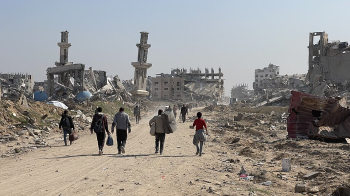
Philippe Lazzarini began by describing the harsh situation on the ground. The horror of the 7 October Hamas attack created a deep collective trauma, leading to an unrestricted Israeli political and military response which is far from respecting international and humanitarian law. Almost eleven months later, Gaza is in a situation that horrifies even the most experienced humanitarian workers. The Geneva Conventions, the moral compass of international humanitarian law, are at risk of becoming irrelevant. And yet, Philippe Lazzarini noted a remarkable reluctance within large parts of the international community to take any meaningful action.
In Gaza, more than 200 UNRWA staff have been killed. 190 UNRWA premises have been damaged or destroyed and at least 560 displaced people have been killed while sheltering in UNRWA buildings under the UN flag. The Israeli Defence Forces and Palestinian armed groups, including Hamas, have used the Agency's premises for military purposes. Clearly marked humanitarian aid convoys have been shot at despite coordinating their movements with Israeli forces. UN-mandated investigators have not been allowed to visit the country. Draft legislation is being discussed in the Israeli Parliament to evict UNRWA from its premises in East Jerusalem, revoke its privileges and immunities, and designate it a terrorist organisation. This would be unprecedented: a UN Member State designating a UN agency, whose mandate is provided by the UN General Assembly, as a terrorist organization. This move has to be rejected in the strongest possible terms.
Additionally, since the war in Gaza began, Israeli authorities have systematically barred international journalists from entering and reporting from Gaza organizing a media blackout. Staff of international NGOs and UN entities have been phased out through the non-renewal of their visas. These actions have now extended to States, with Norwegian diplomats prohibited from operating in the occupied Palestinian territories. If allowed to continue, such attacks against the UN, its agencies, and international NGOs will compromise humanitarian operations worldwide and erode multilateralism and the rule of law globally, warned Philippe Lazzarini.
Answering this analysis, the historian Fania Oz-Salzberger described the situation within Israeli society, emphasizing the deep trauma caused by the dreadful massacre of 7 October and the depth of the consensus generated within Israeli leadership in favour of a solely military solution to defeat Hamas. She also noted a now deeply rooted distrust within the Israeli population toward the United Nations and UNRWA in particular. According to her, the UN is widely considered as systematically hostile to Israel due in particular to the high number of resolutions voted in this framework. I was really shocked by this emphasis on the rejection of the UN as a whole, not only UNRWA. At the same time, she pointed out that there is also strong mobilisation within Israeli society in favour of a ceasefire in Gaza. She asked Europeans to give more support to this section of Israeli opinion, not only by putting pressure on Benjamin Netanyahu's government, but also by stepping up pressure on Hamas and the States that support it.
Dahlia Scheindlin presented us with the results of various surveys carried out in Israel and the occupied territories, which show that support for the two-state solution has plummeted since 2010, when it was as high as 70 %. These polls also show that the Palestinian population's support for the 7 October terrorist attack and Hamas remains high. In Israel and Palestine, public opinion has undoubtedly become more radical, and antagonisms are stronger than ever.
The EU’s unwavering support to the UN and its agencies
For my part, I confirmed the European Union's unwavering support for the United Nations and its agencies, including UNRWA. If there is something to criticise about the United Nations in relation to the Israeli-Palestinian conflict, it is not so much the number of resolutions that are passed - these resolutions are not directed against Israel but against specific policies of its government - as their failure to be implemented, particularly those concerning the ceasefire in Gaza and the settlements in the occupied territories.
As for UNRWA, it plays an irreplaceable role in providing vital humanitarian support to Palestinian refugees not only in Gaza and the West Bank, but throughout the whole region. While some of the agency's staff may indeed have been involved in Hamas's terrorist actions, the report drawn up last spring by Catherine Colonna, the former French Minister of Foreign Affairs, clearly showed that the organisation as such was not at fault and that it put in place the necessary measures to combat possible abuses. These measures have since been further strengthened. It is crucial for the future of the rules-based world order that the EU advocates for the United Nations and its agencies to be allowed to operate freely in the region.
Like Jean-Pierre Filiu, I too am convinced that Europe can and must become much more involved in helping to resolve this conflict, which threatens both its internal stability and that of its immediate neighbourhood, as well as its relations with many countries in the so-called Global South. Our speakers in Santander showed that the level of acceptance of the two-state solution promoted by the EU and the international community is very low today, both in Israel and in the occupied territories. But at different times in the region's history, the situation has been very different. Those who oppose the two-state solution, have to say which alternative solution they propose. The history of the European Union itself shows that it is possible to overcome long-standing and deep-seated antagonisms.
There is nothing definitive about the current state of affairs if we are able to stop the ongoing Gaza war and to build, with the international community and our partners in the region, a credible framework for a just and lasting peace. I have devoted a great deal of effort to this over the last few months, and I will continue to do so until the end of my mandate.
Josep Borrell, High Representative of the European Union for Foreign Affairs and Security Policy / Vice-President of the European Commission