










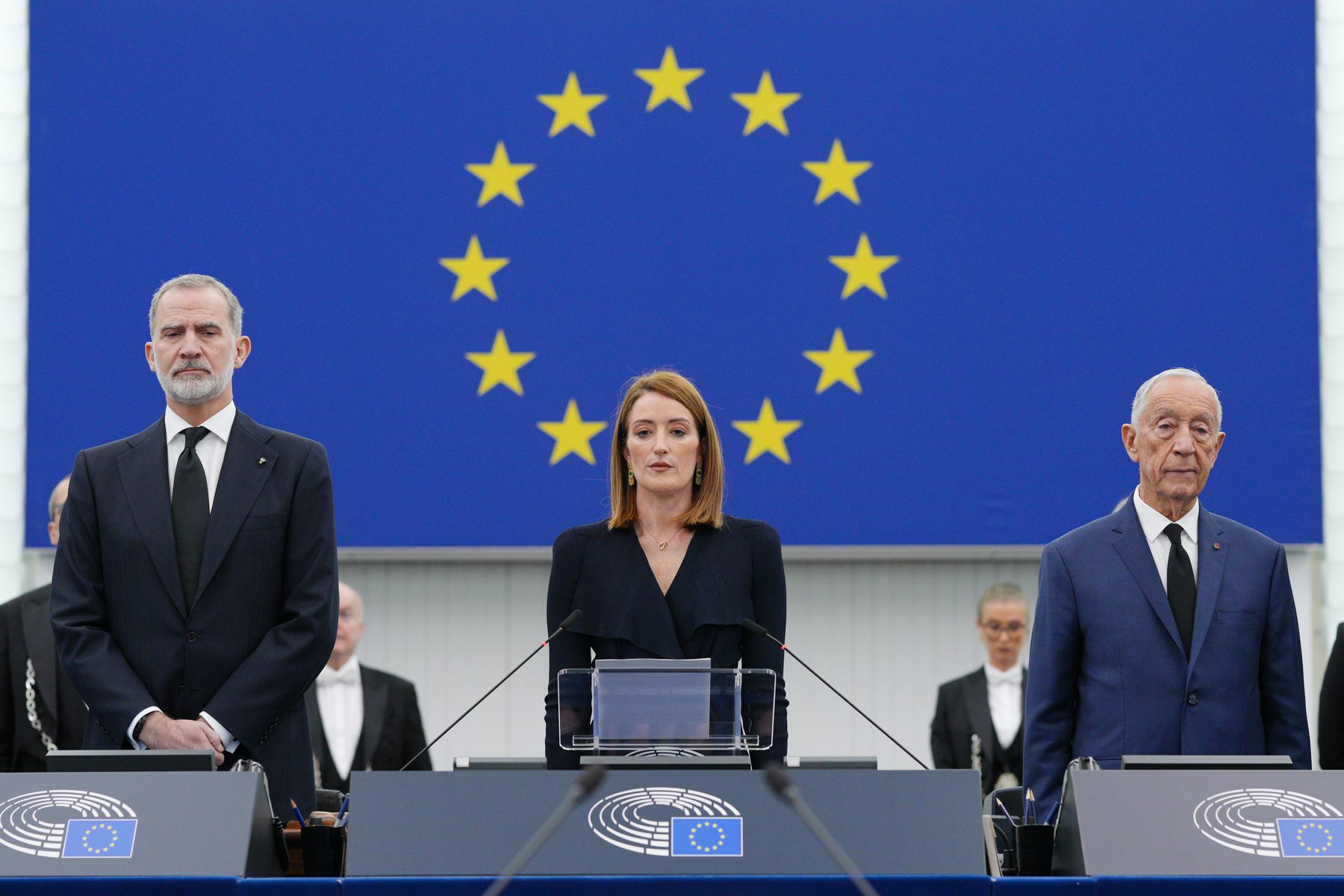
Forty years after Spain and Portugal joined what was then the European Communities, the European Parliament marked the milestone with a solemn plenary session that was as
reflective as it was forward-looking. King Felipe VI of Spain and President Marcelo Rebelo de Sousa of Portugal addressed Members of the European Parliament, underscoring how four decades of EU membership have transformed their countries—and why Europe’s shared project matters more than ever.
Opening the session, European Parliament President Roberta Metsola recalled the historic significance of 1986, when Spain and Portugal formally took their place in the European family. That decision, she said, ushered in “a chapter of freedom and opportunity that changed lives,” not only in the Iberian Peninsula but across the Union. Europe, Metsola reminded MEPs, is never a finished project. “It was never built to stand still,” she said, adding that the next forty years will require the same commitment and collective ambition as the first.
King Felipe VI focused his remarks on Spain’s profound transformation since joining the EU, describing European integration as a catalyst for democracy, prosperity, and stability. In a world marked by uncertainty and conflict, he argued, “never as in these dark times has the idea of Europe been so necessary.” The King stressed that strengthening Europe’s defence capabilities, advancing the EU’s strategic autonomy, and reinforcing the European pillar within the Atlantic Alliance are priorities that “cannot be postponed.”
At the same time, he emphasised the importance of preserving a strong transatlantic relationship based on mutual respect and loyalty. Without it, he warned, Europe would face “a more uncertain, more unstable and more dangerous world.”
King Felipe began his address with a note of solidarity, thanking European partners on behalf of the Spanish people for their messages of support following the recent train tragedy in Adamuz. He then reflected on how Spain has both benefited from and contributed to European integration over the past four decades. The European Union, he said, is “a project of coexistence that has made us all freer, more prosperous, and even stronger.” Any crisis affecting one member state inevitably affects all, he added, concluding with a clear message: Europe’s strength lies in its unity.
Portugal’s President Marcelo Rebelo de Sousa echoed many of these themes, highlighting the tangible benefits EU membership has brought to Portugal, from economic growth to improved living standards. He also pointed to the broader lesson of European integration in a fragmented world: no country can address global challenges alone.
“There is no one today who can remake by force the division of hemispheres from the past, or control their hemisphere, or solve universal problems on their own,” Rebelo de Sousa said, stressing the need for strong international alliances and partnerships.
For Portugal, accession to the European Communities 40 years ago marked a turning point that “changed the history” of both the country and the continent. Today, he noted, the EU represents one of the world’s largest markets, offers comparatively high living standards, and remains a destination admired across the globe.
In closing, President Rebelo de Sousa left no doubt about Portugal’s commitment to the European project. “We Portuguese will never, ever give up on Europe,” he said. “Because giving up on Europe would mean, for Portugal, giving up on an essential and irreplaceable part of Portugal.”
Four decades on, the anniversary served not only as a celebration of past achievements, but also as a reminder that Europe’s future—like its history—will be shaped by shared responsibility, solidarity, and the determination to keep moving forward together.