













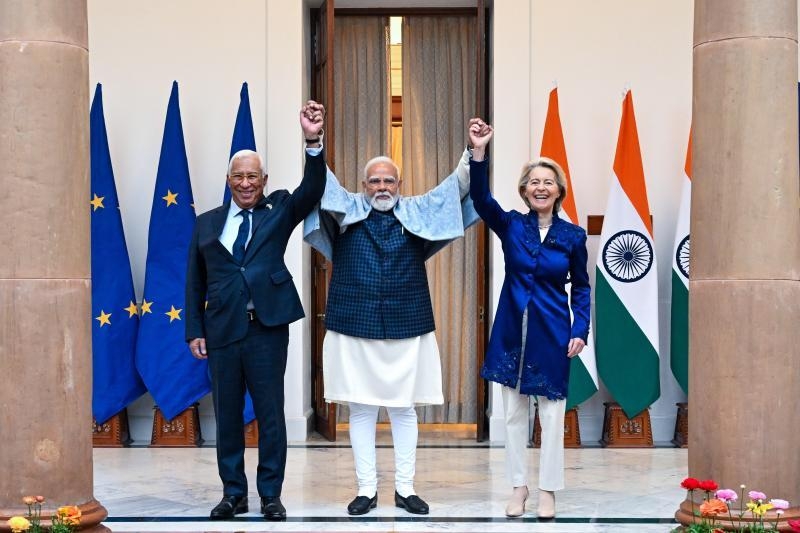
The European Union and India have taken a decisive step toward deepening their relationship at the 16th EU–India Summit in New Delhi, marking what leaders on both sides
described as a transformative moment in their strategic partnership. With the conclusion of a long-awaited Free Trade Agreement (FTA) and the launch of a new Security and Defence Partnership, Brussels and New Delhi are positioning their alliance as one of the most consequential global partnerships of the 21st century.
The political symbolism was clear even before talks began. European Commission President Ursula von der Leyen and European Council President António Costa attended India’s 77th Republic Day celebrations as guests of honour on 26 January—the first time EU leaders have taken part in the event. The gesture underscored the growing closeness between the two partners at a time of global uncertainty.
“In an increasingly volatile world, Europe chooses cooperation and strategic partnerships,” President von der Leyen said at the Summit. Calling the newly signed FTA “the mother of all trade deals,” she highlighted its potential to unlock markets for nearly two billion people, slash tariffs, and boost investment flows. She also stressed that the new Security and Defence Partnership would strengthen resilience against a wide range of threats, from cyberattacks to regional instability.
At the heart of the Summit was the EU–India Free Trade Agreement, one of the largest trade deals of its kind worldwide. The agreement significantly reduces tariff and non-tariff barriers, cutting an estimated €4 billion in duties for exporters. It is expected to spur new trade and investment opportunities, particularly for small and medium-sized enterprises. Around 6,000 European companies already operate in India, a number EU officials expect to rise as clearer, more predictable trade rules take effect. The deal also includes strong commitments on sustainable development, aimed at supporting resilient supply chains and long-term economic security for both sides.
Economic ties were further reinforced through the first-ever EU–India Business Forum, held alongside the Summit, where President von der Leyen and Prime Minister Narendra Modi met business leaders to push for deeper private-sector engagement.
Security cooperation featured just as prominently. Leaders signed the EU–India Security and Defence Partnership, opening the door to closer collaboration on maritime security, counterterrorism, cyber and hybrid threats, space, and non-proliferation. The partnership also strengthens defence industrial cooperation and alignment on defence initiatives. Negotiations were launched on a Security of Information Agreement, a key step toward enabling the exchange of classified information and India’s future participation in EU security and defence missions.
Beyond trade and defence, the Summit delivered a broad package of initiatives in technology, research, and people-to-people ties. The EU and India agreed to establish Innovation Hubs, launch a Startup Partnership, and renew their Agreement for Scientific and Technological Cooperation until 2030. Exploratory talks also began on India’s possible association with Horizon Europe, the EU’s flagship research and innovation programme.
Mobility and skills cooperation gained new momentum with the adoption of an EU–India Comprehensive Framework of Cooperation on Mobility. The agreement aims to facilitate the movement of skilled workers, young professionals, and seasonal workers in sectors facing shortages, while supporting skills development and recognition. A European Legal Gateway Office— the first of its kind—will open in India to help students, researchers, and professionals navigate opportunities in Europe, starting with the ICT sector.
Leaders also endorsed the “Towards 2030: EU–India Joint Comprehensive Strategic Agenda,” which sets out priorities across prosperity, sustainability, technology, security, connectivity, global governance, and cultural exchange. Climate and energy cooperation featured strongly, with both sides reaffirming their commitment to the Paris Agreement and launching a Green Hydrogen Task Force under the EU–India Clean Energy and Climate Partnership.
Connectivity initiatives linking Europe and the Indo-Pacific were advanced as well, including plans for Global Gateway Green Shipping Corridors and hubs, with a regional workshop scheduled in India in 2026. The EU and India also agreed to expand trilateral cooperation in third countries across Africa, Latin America, the Caribbean, and the Indo-Pacific, focusing on clean energy, sustainable infrastructure, and digital resilience.
The Summit’s momentum will continue into early February with the India–EU Forum, a Track 1.5 dialogue bringing together policymakers, industry leaders, and experts from all 27 EU member states and India to translate political commitments into concrete projects.
Together, the outcomes of the 16th EU–India Summit signal a clear ambition: to build a partnership that delivers tangible benefits for citizens, strengthens economic and security resilience, and helps shape a rules-based international order in an increasingly complex world. Photo by ec.europa.eu