











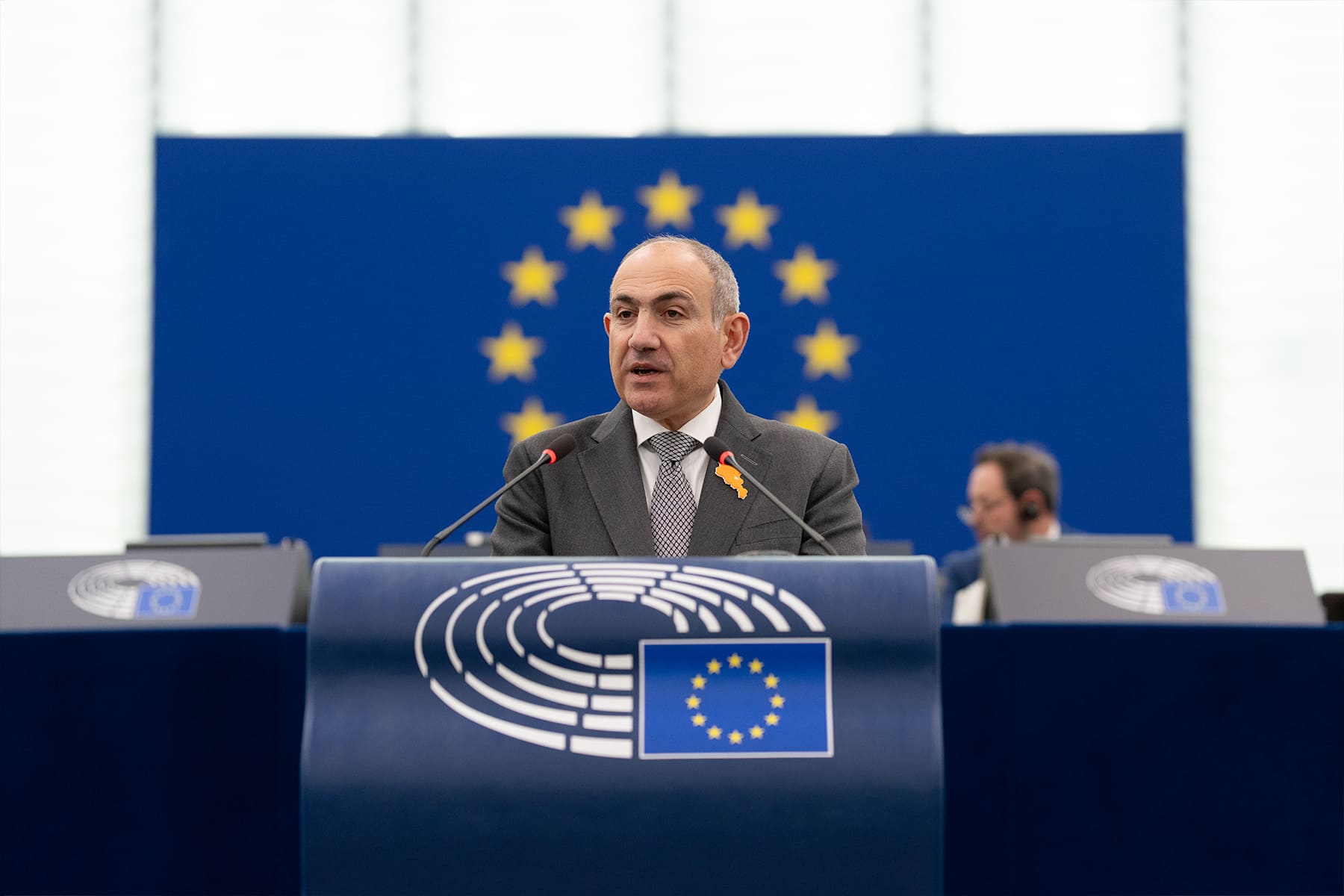
Armenian Prime Minister Nikol Pashinyan addressed members of the European Parliament on Wednesday, describing the recently established peace with Azerbaijan as a historic
shift for the South Caucasus and reaffirming Armenia’s ambitions to move closer to the European Union.
Speaking to MEPs, Pashinyan said that since his previous visit to the parliament in 2023, Armenia and the wider region have experienced changes of “centennial — if not millennial — significance.”
At the center of those changes, he said, is the peace agreement reached between Armenia and Azerbaijan. The deal was formalised on 8 August 2025 in Washington, where Pashinyan and Azerbaijani President Ilham Aliyev signed a joint declaration at the White House, effectively ending decades of conflict between the two countries.
Infrastructure and regional connectivity
Pashinyan also spoke about Armenia’s readiness to move forward with the U.S.-brokered TRIPP infrastructure programme, which aims to create uninterrupted multimodal transport links across Armenian territory. The project would connect mainland Azerbaijan with its Nakhchivan Autonomous Republic, potentially transforming regional trade and connectivity in the South Caucasus.
Domestic challenges and the aftermath of conflict
The Armenian leader acknowledged that the peace process comes amid significant internal and humanitarian challenges. He highlighted ongoing efforts to resettle thousands of Armenians who fled the conflict in Nagorno-Karabakh and are now living in Armenia.
Pashinyan also referred to opposition criticism and resistance from some clergy and political forces, who he said have tried to undermine the government’s peace agenda. Another priority for his government, he noted, remains securing the release of Armenian prisoners of war still being held in Azerbaijan.
Despite criticism that the agreement falls short of a “perfect peace,” Pashinyan defended the deal as a necessary step forward.
“Where has perfect peace ever existed?” he asked lawmakers. “It is the will to care for peace that can bring it as close to perfection as possible.”
Armenia’s path toward the European Union
During his speech, Pashinyan also highlighted Armenia’s growing political alignment with Europe. He pointed to the recent adoption of a law launching the process of Armenia’s accession to the European Union.
The law formally opens the path toward EU membership, though Pashinyan acknowledged that meeting the bloc’s standards will require sustained reforms.
“No country can become a member of the European Union without meeting its standards,” he said, stressing that Armenia must continue implementing reforms with support from European partners.
One of the biggest challenges on Armenia’s European path, he noted, is the current stagnation in political dialogue between the EU and Georgia. Because Georgia serves as Armenia’s main geographic link to Europe, Pashinyan said developments in EU-Georgia relations are crucial for Armenia’s own European ambitions.
Elections and the future of peace
Pashinyan concluded by pointing to Armenia’s upcoming parliamentary elections scheduled for 7 June, saying they should reinforce both democracy and the peace process.
“Our democracy must make peace irreversible,” he said. “And then peace will make democracy irreversible.”