













Germany’s political landscape is shifting sharply, with the far-right Alternative for Germany (AfD) reaching a record level of public support and, for the first time, surpassing the
country’s governing conservative bloc in a major opinion poll.
A survey conducted by Insa for 'Bild am Sonntag' shows the AfD climbing to 28%, up one percentage point from the previous week. The result not only marks a new high for the party—beating its earlier 27% peak—but also represents a significant jump from the 20.8% it secured in Germany’s February federal election.
By comparison, the conservative alliance of CDU/CSU, led by Chancellor Friedrich Merz, stands at 24%. Their coalition partner, the Social Democratic Party (SPD), trails at 14%. Support for the Alliance 90/The Greens has slipped to 12%, while The Left polls at 11%. Smaller parties, including the Sahra Wagenknecht Alliance (BSW) and the Free Democratic Party (FDP), remain below the 5% threshold required for parliamentary representation.
The figures pose a serious challenge for Germany’s current government. Based on these numbers, the CDU/CSU–SPD coalition would fall short of a parliamentary majority, potentially forcing it to seek additional partners such as the Greens or the Left—an arrangement that could prove politically complex.
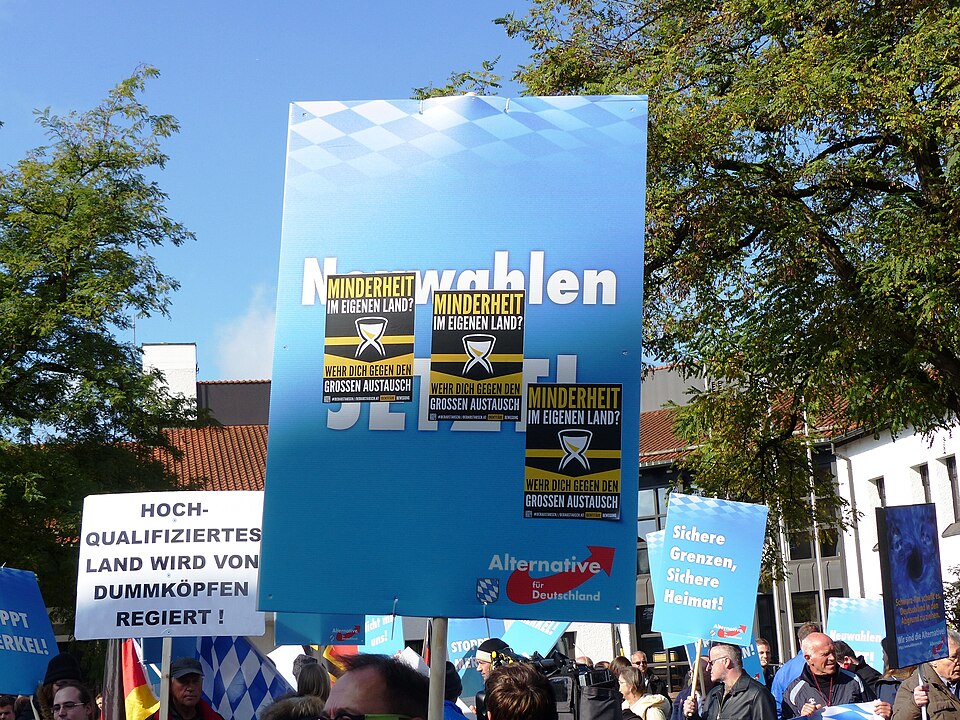
The AfD, co-led by Alice Weidel and Tino Chrupalla, has steadily expanded its voter base in recent years. The party campaigns on a platform centered around strict immigration controls, criticism of the European Union, and a reassessment of Germany’s foreign and energy policies. It has also called for the withdrawal of U.S. troops and nuclear weapons from German territory and has advocated reopening the Nord Stream gas pipeline.
Despite its growing popularity, the AfD remains politically isolated at the federal level. All other parties currently represented in the Bundestag have ruled out forming a coalition with it, citing concerns over its positions and rhetoric. Germany’s domestic intelligence agency has also placed parts of the party under observation over suspected extremist tendencies—an issue that continues to shape the debate around its rise.
Still, the latest polling underscores a broader trend: voter dissatisfaction with mainstream parties is creating space for political challengers, and the AfD is capitalizing on that momentum at a critical moment for Germany’s government. Photo by Metropolico.org, Wikimedia commons.