







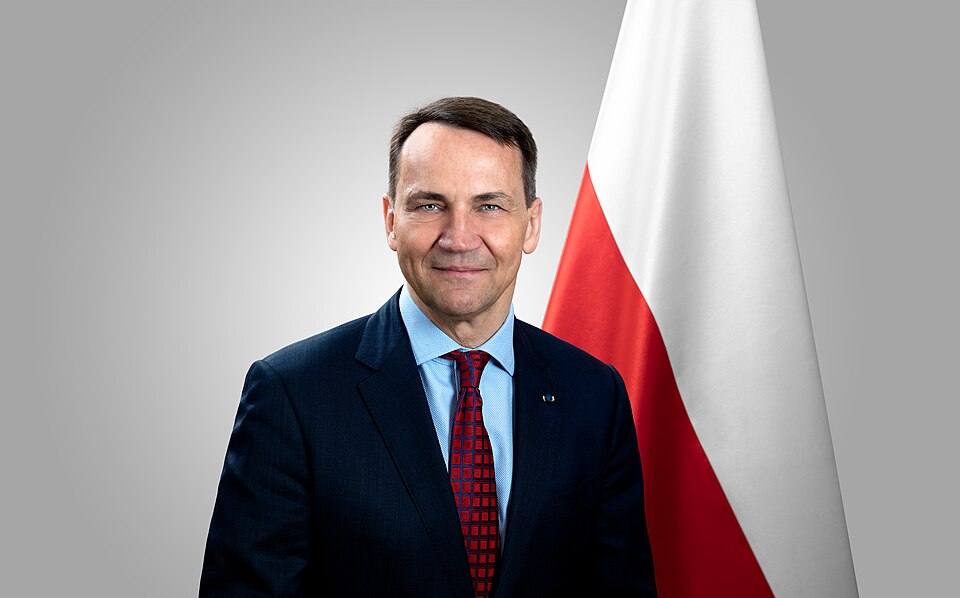
Poland’s foreign minister Radosław Sikorski has warned that relations between Europe and the United States are becoming increasingly strained,
accusing Washington of trying to impose its political and ideological values on its European allies.
Speaking during a debate at the Munich Security Conference on Saturday, Sikorski said that while Europe and the U.S. remain close partners, fundamental disagreements are growing—particularly over freedom of speech, political interference, and the war in Ukraine.
Sikorski pointed to Europe’s historical experience as a key reason for its different approach to free expression. “In Europe, and especially in countries like Poland, promoting fascism or communism is banned for very specific historical reasons,” he said. “We believe in freedom of speech with responsibility.”
He recalled remarks made by the U.S. vice president at last year’s conference, who described Europe’s speech regulations as censorship. “I simply do not accept that interpretation,” Sikorski said, adding that mutual respect for differing political traditions is essential.
“The problem we face today is that one side of the Atlantic is trying to impose its values on the other,” he said. “That is unacceptable.”
Anger over U.S. political involvement in Poland
Sikorski also criticized what he described as U.S. interference in the domestic politics of allied countries, breaking with what he called a long-standing unwritten rule of noninterference. He specifically cited U.S. backing for Karol Nawrocki in Poland’s presidential election.
“That is completely outrageous,” he said. “In Poland, such involvement is irrational and deeply counterproductive.”
The foreign minister noted that Poland has historically been one of the most pro-American nations in Europe, with rival political parties once competing to show who was more supportive of Washington. “But once you start picking sides inside an ally’s political system, everything changes,” he warned.
Sharp criticism of U.S. stance on Ukraine
The debate, which also featured Hillary Clinton and Czech Foreign Minister Petr Macinka, focused heavily on ideological divisions within the West and differing approaches to the war in Ukraine.
Sikorski was particularly critical of the Trump administration’s position on the conflict, accusing it of pressuring Ukraine into concessions to Russia. “I believe that the position of the Donald Trump administration toward Ukraine is shameful,” he said.
He warned that forcing Kyiv into a settlement with Vladimir Putin would amount to a “historic mistake” with long-term consequences for European security.
Defending Europe’s stance on extremism
In exchanges with conservative U.S. political scientist Gladden Pappin and Macinka, Sikorski also defended Europe’s exclusion of extremist parties from the political mainstream. “Yes, we exclude fascists,” he said. “And yes, the threat is still real in Europe.”
His remarks underscored growing unease among European leaders about the future of the transatlantic alliance, as ideological divides and disagreements over democratic norms continue to widen. Photo by Ministry of Foreign Affairs of Poland, Wikimedia commons.