











Inflation across the euro area accelerated sharply in April, reaching its highest level in nearly a year as rising energy and services costs pushed consumer prices higher across
most EU member states.
According to figures released by Eurostat, annual inflation in the euro area rose to 3.0% in April 2026, up from 2.6% in March. The rate stood at 2.2% a year earlier. Across the European Union, annual inflation increased to 3.2% from 2.8% the previous month, compared with 2.4% in April 2025.
The increase was broad-based, with inflation rising in 21 member states compared with March, while five countries recorded declines and one remained unchanged.
Romania posted the bloc’s highest inflation rate at 9.5%, followed by Bulgaria at 6.0% and Croatia at 5.4%. At the other end of the scale, Sweden recorded the lowest annual inflation rate at 0.5%, ahead of Denmark at 1.2% and Czechia at 2.1%.
Services remained the largest contributor to euro area inflation in April, adding 1.38 percentage points to the overall rate. Energy prices also played a significant role, contributing 0.99 percentage points, while food, alcohol and tobacco added 0.46 percentage points and non-energy industrial goods contributed 0.20 percentage points.
Among the eurozone’s largest economies, inflation rose to 2.9% in Germany, 3.5% in Spain, 2.8% in Italy and 2.5% in France. Greece recorded one of the strongest increases among southern European economies, with inflation climbing to 4.6%.
Several smaller economies also saw notable price pressures. Luxembourg’s inflation rate jumped to 5.2%, while Lithuania reached 4.9%. Poland, outside the euro area but within the EU, recorded inflation of 3.4%.
Monthly inflation in April was strongest in Malta, where prices rose 3.4% from March, followed by Cyprus at 2.2% and Luxembourg at 2.0%. Sweden was the only country to record monthly deflation, with prices falling 0.7%.
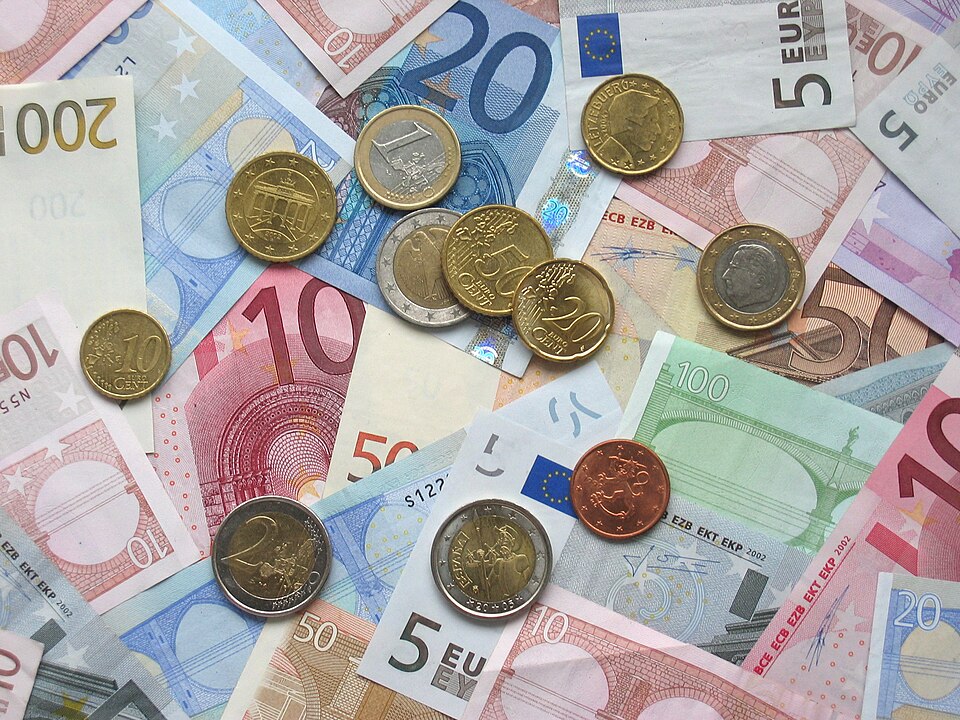
The latest figures are likely to reinforce concerns within the European Central Bank that inflationary pressures remain persistent despite earlier signs of easing at the start of the year. Photo by Avij, Wikimedia commons.