











Thousands of Hungarians filled the streets of Budapest on Sunday as rival political camps staged large demonstrations ahead of the country’s crucial parliamentary election on
April 12. The rallies highlighted the deep political divide in the nation and signaled a heated final stretch of campaigning.
Prime Minister Viktor Orbán called on supporters to mobilize for what he described as a “historic” vote, while opposition leader Péter Magyar drew a huge crowd of backers hoping to end the nationalist leader’s 16-year hold on power.
Rival rallies dominate national day
Both Orbán’s governing party, Fidesz, and Magyar’s emerging opposition movement, Tisza Party, used Hungary’s national holiday on March 15 to show their political strength. The date commemorates the Hungarian Revolution of 1848 against Habsburg rule, making it a symbolic moment for political messaging.
Orbán’s supporters gathered near parliament in Budapest for a pro-government demonstration known as the “Peace March.” The prime minister told the crowd that the upcoming election would determine Hungary’s future direction and urged voters to deliver an even bigger victory than the landslide his party achieved in 2022.
“We must win not just as we did four years ago, but even more convincingly,” Orbán said, arguing that the next government will face historic responsibilities.
Tight race amid economic pressure
The election is shaping up to be one of the toughest challenges Orbán has faced since returning to power in 2010. Hungary has experienced several years of economic stagnation alongside a sharp rise in living costs, creating frustration among voters.
Recent opinion polls suggest the opposition alliance around Magyar could be leading, though the ruling party disputes those figures and cites other surveys predicting a Fidesz victory.
Ukraine war emerges as campaign flashpoint
Orbán has framed the election as a choice between “war and peace,” accusing his opponents of risking Hungary’s involvement in the conflict in neighboring Ukraine following Russia’s 2022 invasion. The opposition rejects those claims and calls them political scare tactics.
The Hungarian leader has frequently clashed with the European Union and maintained relatively cordial relations with Moscow. His government refuses to send weapons to Ukraine and argues that Kyiv should not be admitted to the EU.
Opposition pushes pro-EU message
At a separate rally stretching from the Danube river area toward Heroes’ Square, supporters of Magyar packed one of Budapest’s main boulevards in one of the largest demonstrations against Orbán in years.
Speaking at a venue tied to a defining moment in Hungary’s modern history—where Orbán himself rose to prominence in 1989 by calling for Soviet troop withdrawals—Magyar accused the prime minister of clinging to power.
“Holding onto power at any cost is all that matters to him now,” Magyar said. “He provokes fear of war and uses it as a political weapon.”
Magyar emphasized that Hungary’s future should remain firmly anchored in the European Union and the NATO alliance, though his party has also taken a cautious position on Ukraine, promising a national referendum if the issue of EU membership for Kyiv arises.
A defining election for Hungary
For many voters, the upcoming election feels like a turning point. Some Orbán supporters praised the veteran leader as one of Europe’s strongest politicians. But opposition supporters say another four years of Fidesz rule would deepen Hungary’s political divisions.
“I don’t think this country can handle another four years of this government,” said protester Noémi Szemerszki at the opposition rally.
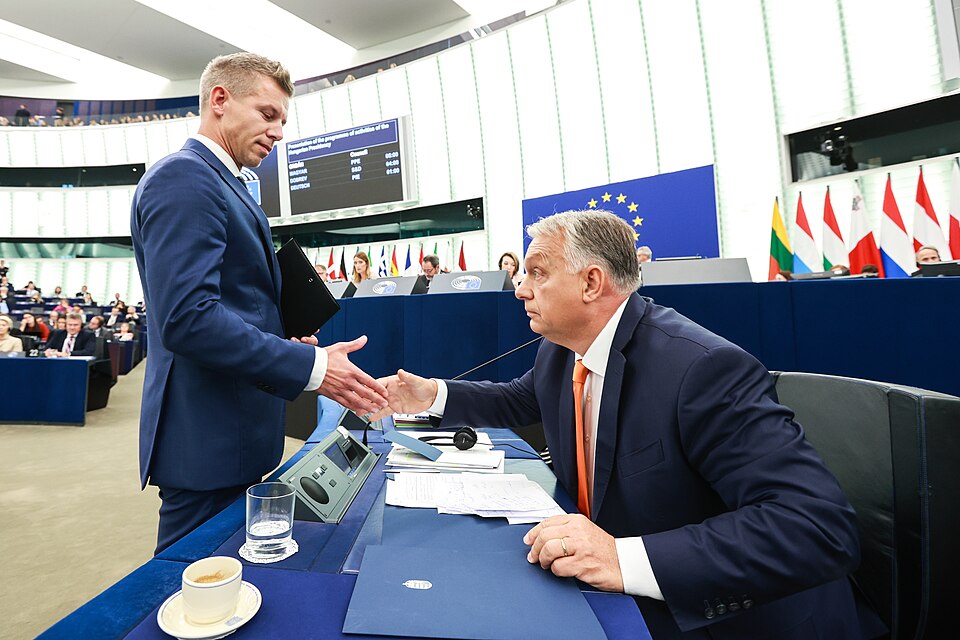
With weeks left before the vote, both camps appear determined to energize supporters and shape the narrative of an election that could redefine Hungary’s political landscape. Photo by © European Union, 1998 – 2026, Wikimedia commons.