




Latest News

Three in four young Europeans have basic digital skills, EU data shows

Three in four young Europeans have basic digital skills, EU data shows Three in four young Europeans have basic digital skills, EU data shows
Nearly three-quarters of young people across the European Union have at least basic digital skills, according to new figures for 2025, although...
Read More...

EU and Ukraine launch drone alliance to speed up defence technology development

EU and Ukraine launch drone alliance to speed up defence technology development EU and Ukraine launch drone alliance to speed up defence technology development
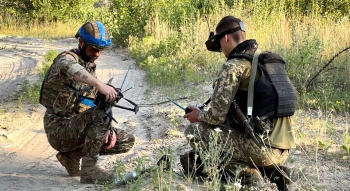
The European Union has formally launched the EU-Ukraine Drone Alliance, a new partnership aimed at accelerating the development and production...
Read More...

EU has fewer judges than a decade ago, with sharp differences between member states

EU has fewer judges than a decade ago, with sharp differences between member states EU has fewer judges than a decade ago, with sharp differences between member states
  The number of professional judges across the European Union has fallen over the past decade, according to new figures, although the picture...
Read More...

EU trade scheme delivered €5bn in tariff savings for developing countries, report says

EU trade scheme delivered €5bn in tariff savings for developing countries, report says EU trade scheme delivered €5bn in tariff savings for developing countries, report says
  The European Union's trade preference programme for developing countries continued to boost exports, support economic growth and encourage...
Read More...

EU opens prestigious Blue Book traineeships to vocational graduates

EU opens prestigious Blue Book traineeships to vocational graduates EU opens prestigious Blue Book traineeships to vocational graduates
  The European Commission has widened access to its flagship Blue Book traineeship programme, allowing graduates from vocational education...
Read More...

EU workers expected to spend longer in employment as average working life reaches 37.5 years

EU workers expected to spend longer in employment as average working life reaches 37.5 years EU workers expected to spend longer in employment as average working life reaches 37.5 years
  People across the European Union are expected to spend more time in the workforce than ever before, with the average working life reaching...
Read More...

EU asylum applications fall by 11% as Venezuelans become largest group of new applicants

EU asylum applications fall by 11% as Venezuelans become largest group of new applicants EU asylum applications fall by 11% as Venezuelans become largest group of new applicants
  The number of people applying for asylum in the European Union fell by 11% in April compared with the same month last year, according...
Read More...

German court jails three more suspects in €50m EU VAT fraud investigation

German court jails three more suspects in €50m EU VAT fraud investigation German court jails three more suspects in €50m EU VAT fraud investigation
  A German court has convicted three more people linked to a major VAT fraud network accused of hiding more than €50 million in tax losses...
Read More...

EU fund to help nearly 2,000 workers hit by job losses in Belgium and Spain

EU fund to help nearly 2,000 workers hit by job losses in Belgium and Spain EU fund to help nearly 2,000 workers hit by job losses in Belgium and Spain
  The European Commission has proposed a €6.5 million support package to help almost 2,000 workers affected by major job losses in Belgium...
Read More...

EU approves €41m Greek aid package to help farmers cope with fertiliser price surge

 EU approves €41m Greek aid package to help farmers cope with fertiliser price surge EU approves €41m Greek aid package to help farmers cope with fertiliser price surge
The European Commission has approved a €41 million support scheme for Greek agricultural businesses hit by rising fertiliser costs linked...
Read More...

Must Read

Most Popular Stories

VIDEO AND audio news:

Features, views, analysis

business

Latest News

Three in four young Europeans have basic digital skills, EU data shows

Three in four young Europeans have basic digital skills, EU data shows Three in four young Europeans have basic digital skills, EU data shows
Nearly three-quarters of young people across the European Union have at least basic digital skills, according to new figures for 2025, although...
Read More...

EU and Ukraine launch drone alliance to speed up defence technology development

EU and Ukraine launch drone alliance to speed up defence technology development EU and Ukraine launch drone alliance to speed up defence technology development
The European Union has formally launched the EU-Ukraine Drone Alliance, a new partnership aimed at accelerating the development and production...
Read More...

EU has fewer judges than a decade ago, with sharp differences between member states

EU has fewer judges than a decade ago, with sharp differences between member states EU has fewer judges than a decade ago, with sharp differences between member states
  The number of professional judges across the European Union has fallen over the past decade, according to new figures, although the picture...
Read More...

EU trade scheme delivered €5bn in tariff savings for developing countries, report says

EU trade scheme delivered €5bn in tariff savings for developing countries, report says EU trade scheme delivered €5bn in tariff savings for developing countries, report says
  The European Union's trade preference programme for developing countries continued to boost exports, support economic growth and encourage...
Read More...

EU opens prestigious Blue Book traineeships to vocational graduates

EU opens prestigious Blue Book traineeships to vocational graduates EU opens prestigious Blue Book traineeships to vocational graduates
  The European Commission has widened access to its flagship Blue Book traineeship programme, allowing graduates from vocational education...
Read More...

EU workers expected to spend longer in employment as average working life reaches 37.5 years

EU workers expected to spend longer in employment as average working life reaches 37.5 years EU workers expected to spend longer in employment as average working life reaches 37.5 years
  People across the European Union are expected to spend more time in the workforce than ever before, with the average working life reaching...
Read More...

EU asylum applications fall by 11% as Venezuelans become largest group of new applicants

EU asylum applications fall by 11% as Venezuelans become largest group of new applicants EU asylum applications fall by 11% as Venezuelans become largest group of new applicants
  The number of people applying for asylum in the European Union fell by 11% in April compared with the same month last year, according...
Read More...

German court jails three more suspects in €50m EU VAT fraud investigation

German court jails three more suspects in €50m EU VAT fraud investigation German court jails three more suspects in €50m EU VAT fraud investigation
  A German court has convicted three more people linked to a major VAT fraud network accused of hiding more than €50 million in tax losses...
Read More...

EU fund to help nearly 2,000 workers hit by job losses in Belgium and Spain

EU fund to help nearly 2,000 workers hit by job losses in Belgium and Spain EU fund to help nearly 2,000 workers hit by job losses in Belgium and Spain
  The European Commission has proposed a €6.5 million support package to help almost 2,000 workers affected by major job losses in Belgium...
Read More...

EU approves €41m Greek aid package to help farmers cope with fertiliser price surge

 EU approves €41m Greek aid package to help farmers cope with fertiliser price surge EU approves €41m Greek aid package to help farmers cope with fertiliser price surge
The European Commission has approved a €41 million support scheme for Greek agricultural businesses hit by rising fertiliser costs linked...
Read More...

Must Read

Most Popular Stories


A newspaper stumbled onto a clause buried in a new law — and suddenly, Germany had a lot of explaining to do.

It took a regional newspaper three months to find it. Buried inside a modernization bill that Germany's parliament approved with barely a murmur last December was a single reworded paragraph — one that, on paper at least, affects roughly 20 million German men and their ability to leave the country.

The Frankfurter Rundschau was the first to surface what both parliament and the media had missed, reporting on April 3, 2026. Within hours, the story had gone national.

Under the newly worded Section 3, Paragraph 2 of Germany's amended Conscription Act, male persons who have reached the age of 17 must obtain approval from the competent Bundeswehr careers centre if they intend to leave Germany for longer than three months. That includes students heading for a semester abroad, professionals taking international assignments, and anyone planning an extended holiday.

From crisis measure to peacetime rule

What makes this legally significant is not just the requirement itself — a version of it existed before — but when it now applies. Previously, an exit-permission requirement for extended stays abroad existed in German law, but only during a declared "state of tension" or "state of defense" under Articles 80a and 115a of Germany's Basic Law, triggered by actual or imminent armed attack. The new law extends the obligation to peacetime, for the first time in the postwar Federal Republic.

In plain terms: Germany has quietly shifted a wartime measure into everyday life, and most of the men it affects had no idea.

The Government's defense — and its admission

Officials at the Defence Ministry moved quickly to reassure the public. A ministry spokesman stressed that as long as military service remains voluntary, approval is in principle regarded as granted — and that the aim was to find a straightforward arrangement for people travelling abroad.

But the reassurance came with an awkward caveat. The necessary administrative regulations had not yet entered into force, meaning the rule technically still formally required approval from a Bundeswehr careers centre before travelling abroad for more than three months — even though the ministry said such approvals were in principle to be granted.

The ministry acknowledged the impact was "profound" and said it was still drafting exemption regulations — without providing a timeline.

A defence spokeswoman explained the logic plainly: "In an emergency we need to know who is potentially staying abroad for a longer period." The goal, in other words, is a functioning military register — a headcount of who is where, should Germany ever need to call men up quickly.

A bureaucratic mess nobody planned for

The Bundeswehr's Career Centres, designed primarily as recruitment offices, have not been resourced or structured for this function. There are no established forms, no published processing times, no clear documentation requirements. Men who left Germany at the start of 2026 for study or work are technically in violation of a rule that didn't exist publicly until April.

Reports indicate that individuals who departed earlier have begun receiving notices requiring them to return to Germany and explain their stay abroad — while the Bundeswehr says its current focus is mainly on informing citizens, records of violations are already being kept.

Opposition politicians were quick to pile on. Several criticised the government over the weekend for creating confusion with sloppy legislation — passing a significant restriction on personal freedom without so much as a public information campaign.

The bigger picture: Germany's military awakening

The travel rule is a symptom of a much larger shift in German strategic thinking — one that has unfolded rapidly since Russia's full-scale invasion of Ukraine in 2022.

For decades, Germany's post-war identity was built around restraint. The country kept defence spending low, relied heavily on American security guarantees through NATO, and was deeply reluctant to project military power. That posture has been crumbling under the pressure of a changed Europe.

In 2022, Chancellor Olaf Scholz declared a Zeitenwende — a historic turning point — and announced a €100 billion special fund to modernise the Bundeswehr. Defence spending, long stuck well below NATO's 2% of GDP target, began climbing in earnest. Under current Chancellor Friedrich Merz, the rhetoric has sharpened further: Germany, he has argued, must be able to defend itself without depending on Washington.

Germany has pledged to increase defence spending to meet NATO's revised guidelines of 3.5% of GDP, and aims to grow the Bundeswehr from approximately 184,000 active troops to between 255,000 and 270,000 by 2035.

Voluntary recruitment has not kept pace with those ambitions. Under the new law, all young men born from 2008 onward will receive a mandatory questionnaire upon turning 18, asking about their willingness and qualifications for military service. Filling it out is compulsory for men, voluntary for women.

Not alone in Europe

Germany is navigating territory that other European countries have already entered. Lithuania reintroduced conscription in 2015, Sweden in 2017, Latvia in 2024, and Croatia voted to reinstate mandatory military service in October 2025. Denmark extended conscription to women in 2025. France, Belgium, and Poland are each launching voluntary service programs in 2026.

None, however, have publicly debated a peacetime exit-permit rule of the kind Germany has now — inadvertently or otherwise — put on the books.

The legal questions ahead

Civil rights organisations have raised concerns about the regulation's breadth, and legal experts are already preparing proportionality challenges in court. The tension with European Union law is pointed: EU citizens generally hold freedom of movement as a near-absolute right, and a peacetime requirement conditioning departure on a military permit — even a nominally automatic one — sits uneasily alongside that principle.

Even men whose conscientious objector status has been formally recognised are not automatically exempt. Applications for conscientious objector status reached more than 3,000 between January and late October 2025, the highest annual count since conscription was suspended.

For now, the Defence Ministry says it is still finalising the procedural details. Until those rules are published, what actually happens to a German man who leaves for a semester abroad without first filing with a Bundeswehr Career Centre remains, by the ministry's own admission, unresolved.

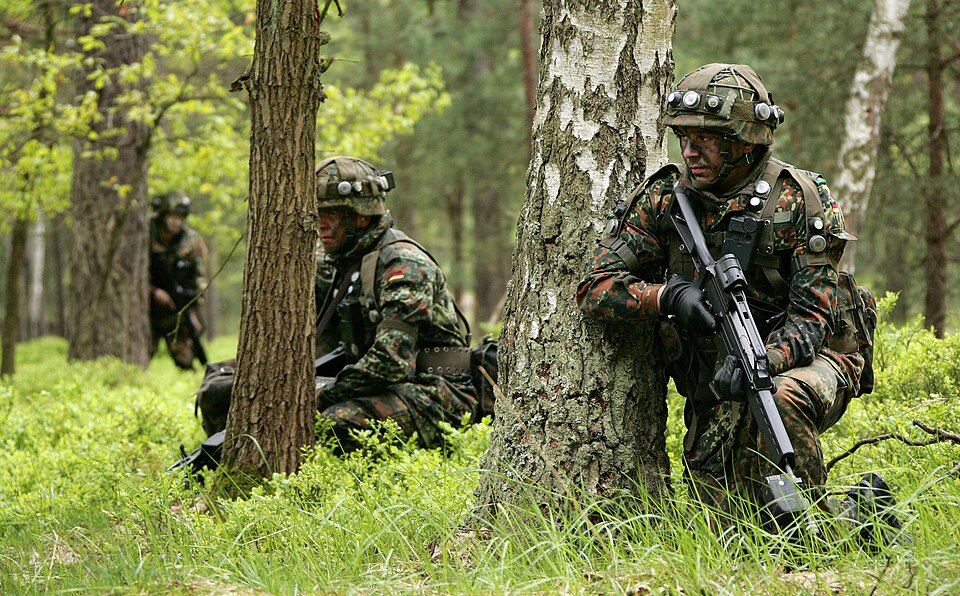
Germany is rearming. It just may not have fully thought through all the paperwork yet. Photo by ©Bundeswehr/S.Wilke, Wikimedia commons.