












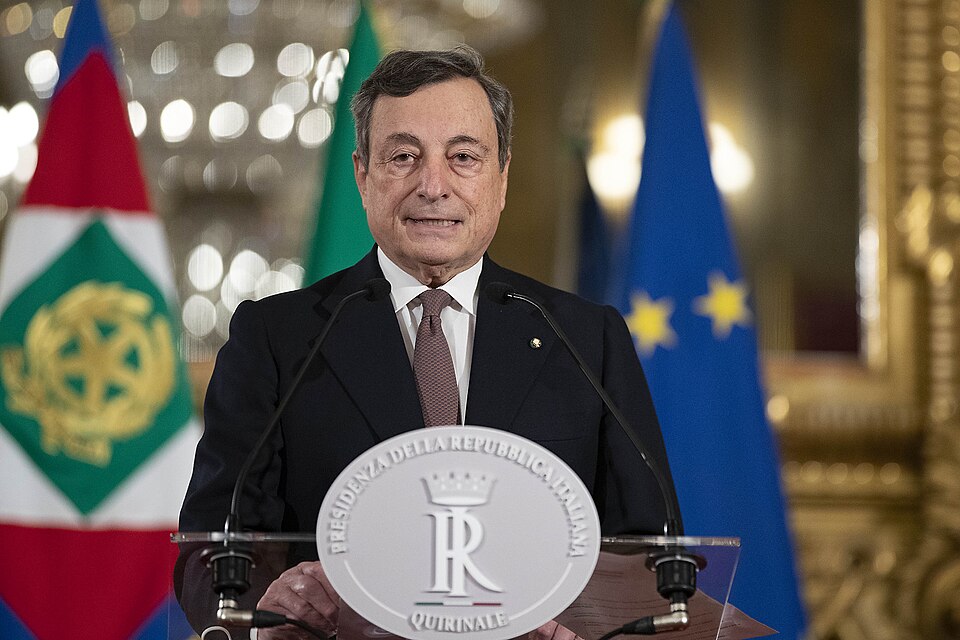
Former European Central Bank President and former Italian Prime Minister Mario Draghi called on the European Union to take a firmer stance toward President Donald Trump’s
United States and embrace what he described as “pragmatic federalism” to respond more effectively to mounting geopolitical challenges.
Speaking Thursday in Aachen while receiving the Charlemagne Prize, Draghi warned that Europe could no longer rely on traditional assumptions about its relationship with Washington.
“The partner we still depend on has become more confrontational and unpredictable,” Draghi said.
“Europe has sought negotiation and compromise.
For the most part, it hasn't worked.
“A posture designed to de-escalate is, instead, inviting further escalation.
“Europe needs the ability to respond more assertively to restore the partnership to a more equitable footing.
“What's holding us back is security.
“The shift in America's attitude toward European security shouldn't be seen merely as a threat.”
Draghi said the changing global order should serve as a wake-up call for Europe, arguing that strategic dependencies must now be reconsidered in a rapidly shifting international landscape.
“It's also a necessary wake-up call.
“In a world where alliances are constantly evolving, every strategic dependency must now be re-examined.
“For the first time in living memory, we are truly alone together.
“Europe is reacting to this new reality. But it is doing so within a system that was never designed to address challenges of this magnitude.”
The former ECB chief said Europe faces an unprecedented moment in postwar history, pointing to growing uncertainty over American security guarantees.
“For the first time since 1949, here is the possibility that the United States may no longer guarantee our security under the conditions we once took for granted.
“Nor does China offer an alternative point of reference.”
Draghi criticized the European Union’s current decision-making structure, arguing that collective action among all 27 member states often falls short during moments of crisis.
“Our current experience is that action at the level of the (EU) 27 often fails to deliver what the moment demands.
“The result is action that can be so inadequate to the scale of the challenge that it becomes worse than inaction.
“We must break this cycle.”
He proposed allowing groups of member states willing to move faster on critical issues to do so without being slowed by the broader bloc.
“The countries that feel the weight of this moment most acutely, and understand that the window for action will not remain open indefinitely, must be free to move forward.
“This is what I have called pragmatic federalism”. Photo by Quirinale.it, Wikimedia commons.